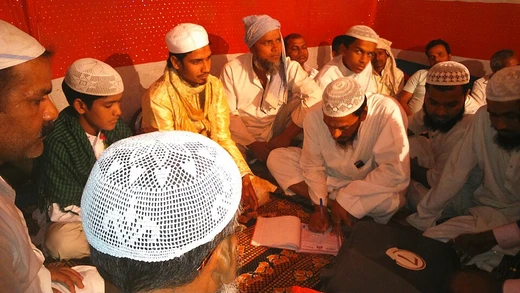
Ramadan
Islamic month of fasting, prayer, and spiritual reflection.

Ramadan is the ninth month of the Islamic calendar, observed by Muslims worldwide as a month of fasting (sawm), communal prayer (salah), reflection, study of the Quran, charity, and strengthening community ties. It is regarded as one of the five pillars of Islam and lasts 29 to 30 days, from one sighting of the crescent moon to the next.
- Type
- Islamic holy month
- Duration
- 29 to 30 days
- Observance
- Fasting from dawn to sunset
- Key practice
- Sawm (fasting), salah, charity
- Significant night
- Laylat al-Qadr (Night of Power)
- Ending holiday
- Eid al-Fitr
Lore & Background
Ramadan is the month in which the Quran is believed to have been revealed to the Islamic prophet Muhammad, known as Laylat al-Qadr. Muslims hold that all scriptures were revealed during Ramadan, including the scrolls of Abraham, Torah, Psalms, Gospel, and Quran. Muhammad is said to have received his first quranic revelation on Laylat al-Qadr, one of five odd-numbered nights during the last ten days of Ramadan.
Reader's Guide
Ramadan is central to Islamic faith and practice, serving as a period of heightened devotion, self-discipline, and community solidarity. Fasting from dawn to sunset is obligatory for all Muslims who have reached puberty and are not exempt due to illness, travel, or other conditions. The predawn meal is suhur, and the nightly feast that breaks the fast is iftar. Spiritual rewards (thawab) are believed to be multiplied during Ramadan, and Muslims refrain from all sinful behavior during fasting hours. The month ends with Eid al-Fitr, which marks the return to normal eating, drinking, and marital intimacy. The Islamic calendar is lunar, so Ramadan migrates through the seasons, and its start is determined by moon sighting or calculation, leading to possible variation by a day between countries.
Did You Know?
- The word Ramadan derives from an Arabic root meaning 'scorching heat'.
- In some hadiths, it is considered prohibited to say only 'Ramadan' without 'month of'.
- Muslims in countries with Persian influence often use the word Ramazan or Ramzan.
- In Shia Islam, the 19th and 21st days of Ramadan mark the assassination and death of Ali.
Academic Positions and Institutional Turbulence
Tariq Ramadan's academic trajectory was marked by both high-profile appointments and repeated institutional conflicts. State Department revoked his H-1B visa under the Patriot Act's ideological exclusion provision, prompting him to resign.
Family Legacy and Intellectual Self-Definition
Ramadan's intellectual identity is deeply intertwined with a family legacy in Islamic reform. His father, Said Ramadan, was a prominent Brotherhood figure exiled to Switzerland by Gamal Abdel Nasser. His great-uncle, Gamal al-Banna, was a liberal Muslim reformer. Despite these roots, Ramadan has described himself as a Salafi reformist, writing and lecturing on Islam, Muslim identity in Europe, and reformist thought. His academic training spans French literature (M.A.) and Arabic and Islamic studies (PhD) at the University of Geneva, with a dissertation titled Nietzsche as a Historian of Philosophy. This combination of Islamic scholarly lineage, European academic formation, and self-identified reformist positioning distinguishes his public intellectual profile from that of more conventional religious scholars.
Criminal Convictions and Legal Proceedings
Ramadan's later years have been dominated by serious criminal proceedings in two countries. The French judgment remains subject to appeal. The Swiss charges included rape and sexual coercion, while the French counts encompassed rape and rape of a vulnerable person. Together, these proceedings across two jurisdictions represent a profound rupture in his public standing, contrasting sharply with his earlier profile as a celebrated academic and public intellectual whose work on Muslim identity in Europe had attracted wide attention.
Political Engagement and International Controversy
Beyond academia, Ramadan built a substantial network of political and interfaith engagement across Europe. He founded the Mouvement des Musulmans Suisses, which organized interfaith seminars, and established the European Muslim Network, a Brussels-based think-tank gathering Muslim intellectuals and activists. He served as an advisor to the European Union on religious matters and was consulted on a commission examining Islam and secularism. However, his outspoken criticism of what he called undemocratic regimes earned him persona non grata status in Tunisia, Egypt, Saudi Arabia, Libya, and Syria, as well as in Israel. These episodes illustrate how his public intellectual work consistently intersected with geopolitical sensitivities.
Frequently Asked Questions
What is Ramadan?
Ramadan is the ninth month on the Islamic lunar calendar and is recognized as one of the five pillars of Islam. During this period, Muslims around the world observe fasting from dawn until sunset while increasing their prayer, Quran study, and charitable deeds.
How long does Ramadan last?
The holy month spans either 29 or 30 days, with the exact length determined by the sighting of the crescent moon at the start and at the close of the period.
What are the main practices during Ramadan?
The central observance is sawm, the voluntary abstention from food and drink between dawn and sunset. Beyond fasting, Muslims place extra emphasis on communal salah, reciting and reflecting on the Quran, giving charity, and strengthening ties within their community.
What is Laylat al-Qadr?
Laylat al-Qadr, commonly called the Night of Power, is regarded as the most sacred night within the month. It is believed to be the night the Quran was first revealed to the Prophet Muhammad, making acts of worship on that evening especially meaningful.
How does Ramadan end?
The month concludes with Eid al-Fitr, a celebratory holiday marking the completion of the fasting period. Communities gather for special prayers, shared meals, and generous acts of giving to close out the season of reflection.
More in Islamic Concepts And Practices 1-16
Spotted an error? Know more?
This is a living reference — every entry is fact-audited, and reader corrections feed straight into our audit queue. Suggest an edit · See this site's audit record