Quran
Central religious text of Islam, believed to be divine revelation.

The Quran (Arabic: الْقُرْآن, lit. 'the recitation' or 'the lecture'), also romanized Qur'an or Koran, is the central religious text of Islam, believed by Muslims to be a revelation directly from God (Allāh). suwar) which consist of individual verses (āyah). Besides its religious significance, it is widely regarded as the finest work in Arabic literature and has significantly influenced the Arabic language.
- field
- Religious text
- language
- Arabic
- revelation_period
- Approximately 23 years
- compilation_start
- Under first caliph Abu Bakr
- standardization
- Under Caliph Uthman (Uthmanic codex)
Lore & Background
Muslims regard the Quran as Muhammad's most important miracle, a proof of his prophethood, and the culmination of a series of divine messages starting with those revealed to the first Islamic prophet Adam, including the holy books of the Torah, Psalms, and Gospel in Islam. The Quran is believed by Muslims to be God's own divine speech providing a complete code of conduct across all facets of life. This has led Muslim theologians to fiercely debate whether the Quran was 'created or uncreated'.
Reader's Guide
It alludes to significant narratives found in biblical and apocryphal texts, but does not quote any paragraph from these sources directly, instead summarizing and using different versions in different sections. Islamic theorists tend to explain this as the Quran's focus on moral lessons. To extrapolate meaning, Muslims rely on tafsir (commentary) and translations. Hadiths, oral traditions later written down reflecting Muhammad's words and actions, serve as additional guidance alongside the Quran for most Muslims. During prayers, the Quran is recited only in Arabic. A person who has memorized the entire Quran is called a hafiz (female hafiza). Verses are ideally recited with a special prosody called tajwid. It is a tradition for some Muslims to recite the entire Quran during the tarawih prayers throughout Ramadan. The Quran is the subject of a modern field of academic research known as Quranic studies. Some argue that manuscript evidence, textual variants (such as the Sanaa manuscript), and historical sources suggest a more gradual and complex process of compilation and canonization.
Did You Know?
- The word 'qur'ān' appears about 70 times in the Quran itself, assuming various meanings.
- The Quran was compiled on the order of the first caliph Abu Bakr after Muhammad's death.
- Caliph Uthman established a standard version known as the Uthmanic codex.
- There are canonical variant readings (qirāʾāt) with minor variations in wording and nuance.
The Shared Framework of Islamic Marriage
While Islamic marriage customs shift considerably depending on a person's country of origin, local government regulations, and even the influence of non-Muslim traditions like wedding cakes, rings, and music, a recognizable skeleton of shared steps remains across most Muslim communities. The Quran provides the overarching legal guidance, yet the lived reality of a wedding is shaped by regional identity and cultural inheritance. The four commonly observed stages are khitbah (the arranging of a partner), nikah (the formal agreement to marry), zifaf or rukhsati (the "sending off" of the bride), and walimah (the wedding banquet). Revivalists and reformers have at times pushed to strip away non-Islamic elements, but in practice many families blend local customs with religious requirements. This tension between a universal script and local flavor is one of the defining features of Muslim marital life across the globe.
Khitbah: The Art of Family-Led Matchmaking
Because Islamic law places strict conditions on interactions between unmarried men and women, the traditional path to marriage in most Muslim societies runs through the families rather than individual romance. The khitbah stage is where representatives of the prospective bride and groom vet one another, comparing personalities, values, and life plans. In theory, this structure prioritizes long-term compatibility over fleeting infatuation or physical attraction. The couple are generally prohibited from meeting alone or touching, and conversations are closely supervised. A woman wearing a niqab may, however, unveil so the suitor can see her face. Once both sides agree to proceed, the relationship enters a committed phase loosely comparable to an engagement, though the term "fiancé" is not used in Islamic terminology. Regional flavors differ: Arab cultures tend to emphasize elaborate familial approval ceremonies, South Asian traditions often center on social alliance and the exchange of gifts and jewelry, and Southeast Asian communities frequently weave in local customs that give the engagement a more communal character. A pious alternative called "halal dating" lets the two meet in public with a chaperone or friends, focusing on faith, personality, and mindset rather than physical contact.
The Nikah Ceremony: Consent, Contract, and Community
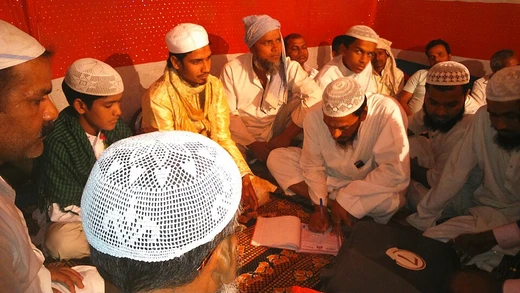
The nikah is the moment a couple formally becomes husband and wife, structured as a two-part act: a verbal exchange of consent followed by the signing of a written marriage contract. The ceremony requires the groom, the bride, her wali (her Islamic legal guardian, typically her father), two Muslim witnesses, and an officiant—usually an Imam, though a judge (qadi) may serve in that role. The venue need not be a mosque; a private home or a qadi's office is equally valid. The wali first asks for the bride's consent, then for the groom's commitment, before declaring the marriage. Both respond "Qubool," meaning "I accept," three times. After the contract is signed, those present recite the fatihah, the opening surah of the Quran. A wedding sermon, or khutbah, then follows, traditionally opening with verses from Surah An-Nisa, Surah Al Imran, and Surah Al-Ahzab. Underpinning the entire process is the mahr, a mandatory gift from the groom to the bride for her exclusive use, whose amount and form must be agreed upon beforehand. Because secret marriages can lead to disputes, a public announcement of the union is strongly encouraged so the community recognizes the couple's new status.
Early Marriage and the Question of Age
Islam strongly encourages young men and women to marry as soon as they are able, on the grounds that the family is the foundation of Islamic society and that pre-marital sexual relations are forbidden. The Quran references "baligh," or puberty, as a marker of maturity, and in many traditional interpretations reaching puberty is treated as the minimum threshold for marriage, even though physical and emotional maturity are acknowledged as important considerations. In practice, Muslim-majority nations have established legal minimum ages that vary: Egypt sets the minimum at eighteen for both men and women, while Indonesia requires women to be nineteen and men to be twenty-one. In Pakistan and Afghanistan, child marriage is technically illegal, yet it still occurs due to weak enforcement and deeply rooted cultural practices. The broader Islamic marital jurisprudence also permits a man to have up to four wives simultaneously, a provision that adds another layer of complexity to how marriage is structured and regulated across the Muslim world. The interplay between religious encouragement, legal codification, and local custom makes the question of when a person is "ready" to marry one of the most debated issues in contemporary Islamic life.
Frequently Asked Questions
What are Quran's powers/role?
The Quran functions as the ultimate guide for Islamic belief, law, ethics, and daily worship for over a billion followers worldwide. Beyond its spiritual authority, it is widely regarded as a pinnacle of Arabic literature and has profoundly shaped the Arabic language itself.
Why is Quran important?
For Muslims, the Quran is the literal speech of God and the foundational source for all theology, jurisprudence, and moral life. It also carries enormous cultural weight as one of the most influential works ever composed in Arabic, touching on poetry, philosophy, and natural observation.
More in Islamic Concepts And Practices 1-16
Spotted an error? Know more?
This is a living reference — every entry is fact-audited, and reader corrections feed straight into our audit queue. Suggest an edit · See this site's audit record