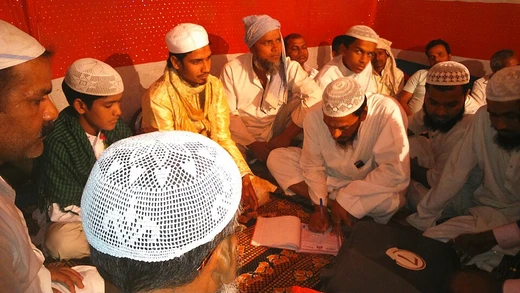
Islamic schools and branches
Diverse sects, schools, and movements shape Islamic belief and practice.

Islamic schools and branches encompass the diverse sects, denominations, schools of jurisprudence, and schools of theology within Islam. They matter because they shape the beliefs, practices, and identities of Muslims worldwide, and differences among them have sometimes led to political and religious violence.
- largest_denomination
- Sunnī Islam (87–90% of Muslims)
- second_largest
- Shīʿa Islam (10–13% of Muslims)
- surviving_kharijite_branch
- Ibadi
- main_sunni_jurisprudence_schools
- Ḥanafī, Mālikī, Shāfiʿī, Ḥanbalī
- main_shia_sects
- Twelvers, Ismāʿīlīs, Zaydīs
- non_denominational_muslims
- Those not classified under identifiable schools
Lore & Background
The original schism between Kharijites, Sunnīs, and Shīʿas arose over political and religious succession after Muhammad's death. Kharijites broke away during the First Fitna, adopting extreme doctrines including takfīr against both Sunnīs and Shīʿas. Sunnīs believe Abu Bakr was the rightful successor, while Shīʿas hold that ʿAlī ibn Abī Ṭālib was the true successor. Within Sunnī Islam, four main schools of jurisprudence exist: Mālikī, Ḥanafī, Shāfiʿī, and Ḥanbalī. Shīʿa Islam divides into Twelvers, Ismāʿīlīs, and Zaydīs, with most Shīʿa being Twelvers. Ismāʿīlīsm later split into Nizārī and Musta'lī, and further into Ḥāfiẓi and Ṭayyibi branches. Kharijites initially had five major branches, but only Ibadis survive. Newer movements include Ahmadi Muslims, Quranist Muslims, and African-American Muslims. Some groups, such as Barelvism, Deobandism, Salafism, and Wahhabism, have induced enough passion to result in political and religious violence. Non-denominational Muslims are those who do not belong to or self-identify with any identifiable school.
Reader's Guide
The significance of Islamic schools and branches lies in their profound impact on the global Muslim community. Sunnī Islam, comprising 87–90% of Muslims, is the largest denomination, while Shīʿa Islam makes up 10–13%. The original schism over succession after Muhammad's death created lasting divisions, with Kharijites, Sunnīs, and Shīʿas emerging during the First Fitna. Within Sunnī Islam, four major jurisprudence schools—Ḥanafī, Mālikī, Shāfiʿī, and Ḥanbalī—coexist alongside theological schools like Atharī, Ashʿarī, and Māturīdī. Shīʿa Islam includes Twelvers, Ismāʿīlīs, and Zaydīs, with Twelvers forming the vast majority. The legacy of these divisions includes both peaceful coexistence and violent conflict, as seen in tensions between Sunnīs and groups like Ahmadiyya, Alawites, Quranists, and sometimes Shīʿas. Some movements, such as Islamic modernism and Islamism, are informal, while others like the Nation of Islam are organized. Historically influential groups like non-Ibadi Kharijites and Murji'ah no longer exist. The diversity of schools and branches continues to shape Islamic theology, law, and identity, with non-denominational Muslims representing those outside identifiable categories.
Did You Know?
- Sunnīs make up 87–90% of all Muslims, while Shīʿa comprise 10–13%.
- The original schism between Kharijites, Sunnīs, and Shīʿas was over political and religious succession after Muhammad's death.
- Only the Ibadi branch of the Kharijites survives today; other branches like Sufris, Azariqa, Najdat, and Adjarites are extinct.
- Non-denominational Muslims are those who do not belong to, do not self-identify with, or cannot be classified under an identifiable Islamic school or branch.
The Succession Crisis That Shaped Islam's Denominational Map
The foundational division in Islam was not primarily theological but political. Sunnis recognized Abu Bakr as the legitimate first caliph, while Shias insisted that Ali ibn Abi Talib was the true successor chosen by divine will. The Kharijites emerged during the First Fitna—the first Islamic civil war—breaking away from both camps. What distinguished the Kharijites was their radical doctrine of takfir, declaring both Sunni and Shia Muslims to be either infidels (kuffar) or false believers (munafiqun) worthy of death for perceived apostasy (ridda). From what began as essentially a political position, the Kharijites developed extreme theological stances that set them apart from both mainstream traditions. This single event of succession dispute generated the three major denominational families that would define Islamic history for over a millennium, each carrying forward distinct understandings of authority, legitimacy, and community.
The Architecture of Sunni Legal and Theological Pluralism
Within the Sunni majority—accounting for roughly 87 to 90 percent of all Muslims worldwide—there exists a layered architecture of intellectual tradition. Jurisprudential thought is organized into four major madhabs, each named for its founding scholar: the Maliki school after Malik ibn Anas, the Hanafi school after Abu Hanifa al-Nu'man, the Shafi'i school after Muhammad ibn Idris al-Shafi'i, and the Hanbali school after Ahmad ibn Hanbal. Alongside these legal frameworks, Sunni theology branches into three distinct schools of creed: the Athari, the Ash'ari, and the Maturidi. Sufi traditions add yet another dimension through their various tariqas, or spiritual orders. What makes this internal diversity particularly complex is the ongoing contest over who represents orthodox Sunni Islam. Classical scholars of jurisprudence and rationalistic theology (kalam) on one side, and literalist movements such as Wahhabis and Ahle Hadith on the other, have laid competing claims to that label. Islamic modernism, described as an offshoot of the Salafi movement, attempted to bridge this divide by reviving Mu'tazila-era rationalism through scholars like Muhammad Abduh.
The Shīʿa Family Tree and Its Jurisprudential Unity
Shia Islam, the second-largest denomination comprising roughly 10 to 13 percent of the global Muslim population, presents a branching structure that is both intricate and, in one crucial respect, unified. The three major Shia sects are Twelvers, Ismailis, and Zaydis. Twelvers dominate the Shia world so overwhelmingly—accounting for approximately 85 percent of all Shia Muslims per a 2012 estimate—that the word Shia in common usage often refers to them by default. Both mainstream Twelver and Ismaili communities follow the Ja'fari school of jurisprudence, named after Ja'far al-Sadiq, the sixth Imam in Shia tradition. Zaydis, sometimes called Fivers, follow their own distinct legal school named after Zayd ibn Ali. The Ismaili branch itself underwent further subdivision: it split into Nizari and Musta'li lines, and the Musta'li further divided into Hafizi and Tayyibi. The Tayyibi Ismailis, commonly known as Bohras, are themselves split among Dawudi, Sulaymani, and Alavi Bohras. Despite this elaborate genealogy of sub-branches, the shared Ja'fari legal framework binds the largest Shia communities under a single jurisprudential umbrella.
Living Traditions, Extinct Schools, and the Non-Denominational Space
The landscape of Islamic denominations is neither static nor complete. Some groups trace their origins to the seventh and eighth centuries—the Kharijites, the Mu'tazila, the early Sunni and Shia formations—while others are products of the modern era. Islamic neo-traditionalism, liberalism, progressivism, modernism, Salafism, and Wahhabism all emerged in more recent centuries, and the Nation of Islam arose in the twentieth century as an organized group with its own governing body. Meanwhile, entire traditions have vanished from the historical record: the non-Ibadi Kharijite branches (Sufris, Azariqa, Najdat, Adjarites) and the Murji'ah no longer exist as living communities, leaving only the Ibadi Kharijites as a surviving remnant of that early schism. Beyond these identifiable schools, a category of non-denominational Muslims exists—individuals who do not affiliate with, self-identify under, or can be readily classified within any particular branch. This residual space, alongside informal idea-driven movements like Islamism and Islamic modernism, reminds us that the taxonomy of Islamic identity is far from exhaustive.
Frequently Asked Questions
What are Islamic schools and branches?
Islamic schools and branches refer to the various sects, denominations, and legal-theological traditions that have developed within the Muslim community over many centuries. They include major denominations such as Sunnī and Shīʿa Islam, as well as specific schools of jurisprudence and theology nested within those denominations.
What role do Islamic schools and branches play in a Muslim's daily life?
These schools shape how a Muslim prays, fasts, conducts transactions, and understands core doctrines, since each tradition offers its own interpretive framework for the faith's primary sources. A person's affiliation with a particular school often influences their ritual details, legal rulings, and even their broader social identity.
How did Islamic schools and branches come to be?
The diversity emerged gradually as early Muslim communities debated how to interpret the Quran and the Prophet's example, leading to distinct legal and theological traditions that crystallized over the first few centuries of the faith. Political splits, such as the dispute over leadership succession, further cemented separate denominational lines that persist to this day.
Why are Islamic schools and branches important to understand?
They account for the vast majority of the world's Muslim population and determine the practical religious lives of billions of people. Grasping these distinctions also helps explain historical and contemporary tensions, since differences among schools have at times fueled political and sectarian conflict.
What are the largest Islamic schools and branches?
Sunnī Islam is by far the largest denomination, encompassing roughly 87–90 percent of all Muslims, while Shīʿa Islam forms the next tier at about 10–13 percent. Within Sunnī Islam, four classical schools of jurisprudence—Ḥanafī, Mālikī, Shāfiʿī, and Ḥanbalī—remain the most widely followed legal traditions.
More in Islamic Concepts And Practices 1-16
Spotted an error? Know more?
This is a living reference — every entry is fact-audited, and reader corrections feed straight into our audit queue. Suggest an edit · See this site's audit record